 Eric Boggs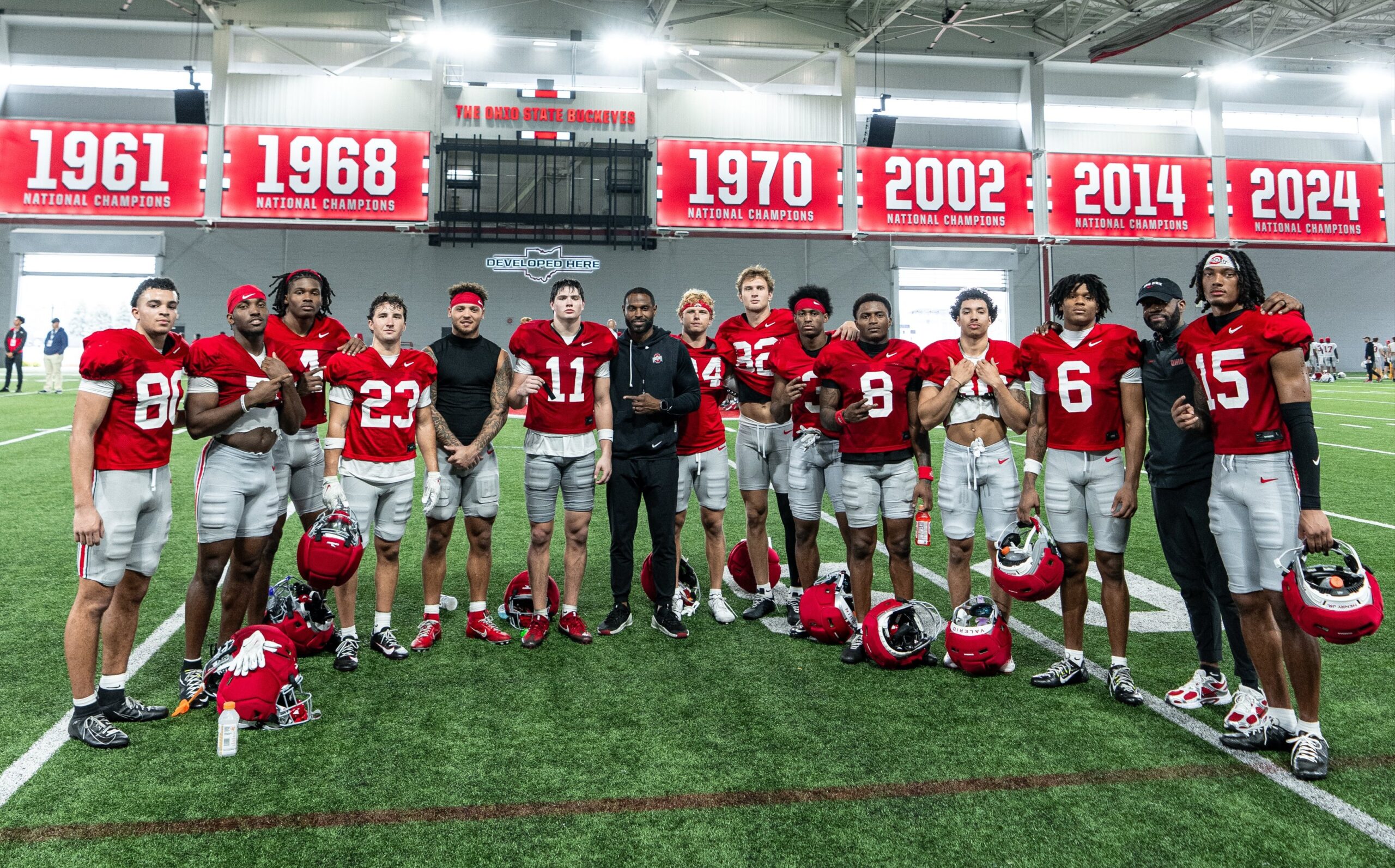
There’s always a certain level of anxiety within the Ohio State fanbase when projecting the next wave of wide receiver talent, especially given the program’s standard of excellence at the position. But early this spring, that familiar uncertainty has quickly turned into intrigue—and growing excitement—thanks to the emergence of freshman Brock Boyd.
In a program where the black stripe tradition symbolizes the transition from newcomer to trusted contributor, Boyd wasted no time making his mark. Shedding his stripe after just six practices, he became the third-fastest freshman to do so since the tradition began under Urban Meyer. The only players to accomplish the feat faster were Jeremiah Smith and Carnell Tate—two names that now carry significant weight in Columbus.

That context alone is enough to grab attention. Smith went on to deliver the most prolific freshman season in school history, while Tate developed into one of the nation’s premier receivers and a projected top-10 NFL draft pick. Even Austin Mack, the only other receiver to lose his stripe in March prior to Boyd, carved out a solid career in scarlet and gray. History suggests that when a freshman earns trust this quickly, it’s rarely by accident.
What makes Boyd’s rise even more compelling is that it wasn’t expected—at least not to this degree. Unlike many of Ohio State’s recent stars at receiver, Boyd didn’t arrive in Columbus as a five-star headline grabber. He was a three-star prospect, ranked outside the top 700 nationally. Yet from the moment he stepped onto the practice field, he’s looked anything but ordinary.

Ryan Day didn’t hesitate to acknowledge that impact, pointing to Boyd’s polish and production early in camp. His ability to run precise routes, create separation with quickness, and consistently make plays has stood out. There’s also a maturity to his game that reflects his background, as the son of a high school receivers coach. That foundation shows up in his instincts and understanding of the position, traits that wide receivers coach Cortez Hankton has praised as being well beyond his years.
From a fan’s perspective, it’s hard not to draw parallels to past breakout stars. Ohio State’s receiver room has long been a pipeline of elite talent, producing names like Jaxon Smith-Njigba, Marvin Harrison Jr., and Garrett Wilson. Boyd now finds himself mentioned alongside that lineage—not because of recruiting hype, but because of what he’s already proving on the field.

Still, expectations should remain measured for the immediate future. Unlike Smith, who stepped in as an instant starter, Boyd enters a crowded and competitive receiver room. Veterans like Kyle Parker and Devin McCuin, along with highly touted freshman Chris Henry Jr. and Jerquaden Guilford, will all be pushing for playing time alongside established targets like Smith and Brandon Inniss. The path to significant snaps won’t be handed to him.
But what Boyd has already accomplished suggests he won’t shy away from that challenge. In fact, he’s already forcing his way into the conversation. His production at Southlake Carroll, where he amassed over 3,300 receiving yards across his final two high school seasons, hinted at untapped potential. Now, that potential is beginning to translate at the next level.

Spring practice has also revealed that Boyd isn’t alone in making noise. Transfers like Earl Little Jr. have impressed on defense, while Jay Timmons continues to rise in the secondary. Henry Jr., as expected, has flashed the elite traits that made him a five-star recruit. Yet even among that group, Boyd’s early consistency and rapid development have made him one of the most talked-about newcomers.
For Ohio State fans, that’s the most encouraging part. The Buckeyes don’t need Boyd to be the next immediate superstar—but if early signs are any indication, they may have found another playmaker who can carry the tradition forward. And in a receiver room defined by greatness, that’s saying something.